Aristotle and the Arts (and why it matters)

Updated: Sep 10, 2025
"What kind of knowledge do we hope to derive from reading novels, which tell us stories which are not "true"? One traditional answer to that is: knowledge of the human heart, or mind."
David Lodge, The Art of Fiction
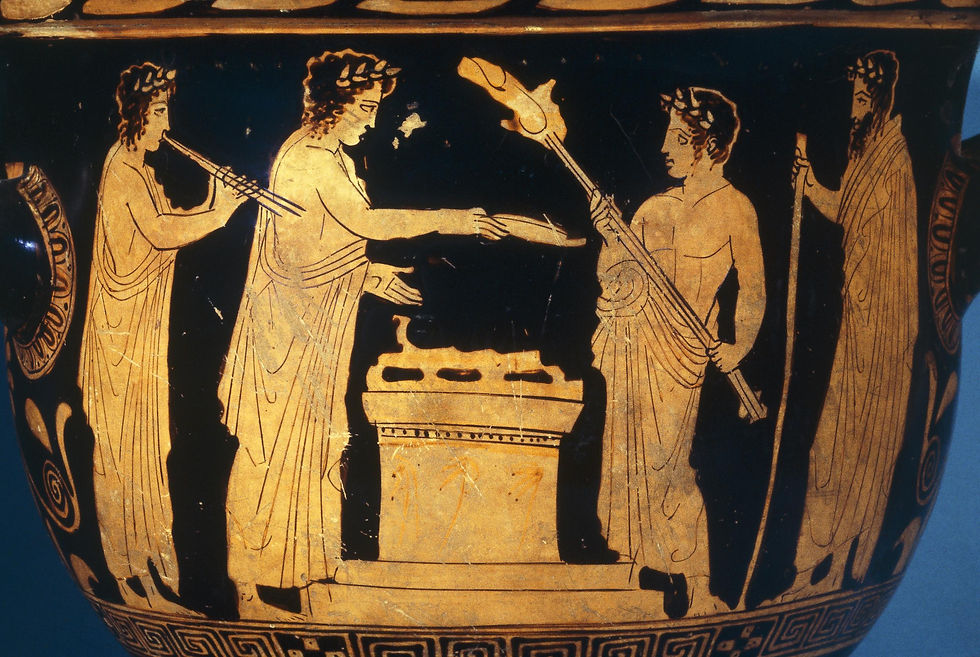
Aristotle knew well that literature can equip us with a powerful understanding of human experience. To the ancient Athenians theatre (performance of tragic plays in poetry) was an essential part of civic life, of the healthy functioning of democracy, and of personal moral development. Aristotle, a Macedonian who first arrived in Athens to study philosophy, recognised that “poetry is more philosophical and more serious than history."(1)
The Aristotelian philosopher Martha Nussbaum develops this idea and extends it to the role of literature in modern life. She explains that literature engenders in the reader “a richly qualitative kind of seeing”(2) as we learn to hone our powers of perception to apply what Aristotle called phronesis, or practical moral wisdom, to our own situations. Another neo-Aristotelian, David Carr, describes “the central role of literature and the arts in any process of moral formation – properly conceived as an education of the heart as well as the head.”(3)
At at time when the arts and humanities are undergoing endless rounds of cost-cutting in schools and universities, and when theatres and libraries and museums are losing funding, it's important to remind the world why they matter. They always matter. And in a world experiencing war and famine, climate crisis, the rapid advance of genAI, fake news, and increasing disparity between rich and poor, they really matter. At the heart of all the human-caused problems in the world there are always choices; we can always choose to make the world a better place. One of the powers of literature and the arts more broadly is to help us to understand our choices and how to make better ones.

Literature and the arts extend our awareness of life and its possibilities beyond our own experience; we develop empathy and compassion for others whose life experiences we may not have been able to imagine otherwise. The ancient Athenians experienced this by watching plays about mythical characters in situations which were far removed from their own, but which provoked universally recognisable emotions. The protagonist of a play would have difficult moral choices to make, and the audience would engage their own moral emotions in their absorption in the drama. As Oliver Taplin puts it, "Tragedy calls for understanding and sympathetic fellow feeling toward the situations and sufferings of other, very different people; and a thoroughgoing democracy arguably calls for an enhanced sense of the variousness of humanity and human suffering. Open-mindedness and plurality of viewpoints are needed if true participation in any society is to become extended to all its citizens."(4)
We have a far wider range of literature to choose from, and unlike the Greeks we have it on demand (we don't need to wait for a festival, we simply reach for a book, a podcast, a film). This potentially diminishes the positive effect on democracy that Taplin attributes to Athenian theatre, as we can select which viewpoints to hear, which people and situations to observe. But on the other hand we have so much more choice available to us to open up our worlds of experience. So why are children reading fewer books(5), and what can we do about it?
The reasons are pretty clear: there are so many other distractions for both children and parents. But this isn't just a matter of literacy and education; as we've seen it is also a matter of empathy, of understanding our fellow humans including those from very different backgrounds and with different views, and of learning to make good, ethical choices. An education in STEM or economics alone would make someone employable and knowledgeable in some areas, but it wouldn't help them make good life choices, or think critically about the news and opinions they're presented with in the media, or understand historical events to help them make better political choices in the present.
So how do we cut through the noise of the other distractions (often well-funded and highly profitable to their billionaire owners) to help strengthen literature and the arts, and our engagement with them? Here are a few ideas, and I'd love to hear other suggestions.
We need to let people know the arts matter: we can speak up to schools, government, councils, broadcasters, funding organisations, and the public. Tell your MP and councillors why your library needs to stay open; tell your schools to offer drama, art, creative writing clubs; tell broadcasters that you want them to deliver cultural content. Share your views widely!
We can support the arts and creative industries: make every gift you give a child include a book (whatever you think will engage them: novel, graphic novel, weirdly niche encyclopaedia...); give friends and family gifts of cultural experiences (theatre, art, music, comedy performance). It's better for the environment than most gifts and often more meaningful.
We can remind people of the importance of the arts - and the joy they bring: even amidst the noise there are people who want to listen and realise others feel the same. In our increasingly lonely and polarised society, we can bring people and communities together through culture and the arts.
And so importantly, we can help every child we can to learn to love books. Fight to keep libraries open; donate to literacy and book charities; share your enthusiasm. It'll empower their minds, their hearts, their souls.
(1) Aristotle (1996) Poetics. Trans. Heath, M. London: Penguin Books.
(2) Nussbaum, M. (1990) Love’s Knowledge: Essays on philosophy and literature. Oxford: Oxford University Press.
(3) Carr, D. (2005) “On the contribution of literature and the arts to the educational cultivation of moral virtue, feeling and emotion,” Journal of Moral Education 34 (2), pp. 137 – 151.
(4) Taplin, O. (2018) The Oresteia, A New Translation. New York: W.W. Norton and Company.
(5) National Literacy Trust https://literacytrust.org.uk/reading-for-pleasure/
Comments